Many teams still stitch together spreadsheets and email threads to keep BPMN diagrams in sync with actual workflows. When a process change hits one tool but not the other, audit files break and deadlines slip.
By the end of this article you will have a short list of concrete criteria, a direct comparison of three tools, and a clear ranking that names the best overall option for BPMN based automation. You will also see how Process Street stacks up against Camunda and where each product fits different process volumes and audit demands.
What to Look For in BPMN-Based Workflow Automation Tools
BPMN-based workflow automation tools must combine standardized process modeling with execution and governance capabilities.
Teams evaluating these platforms should verify six core features before making decisions. Native BPMN 2.0 import and export ensures compatibility across different modeling environments and vendors.
Executable process diagrams allow organizations to run their designed workflows directly without converting to separate execution languages. This reduces errors and speeds up deployment cycles significantly.
Process versioning tracks changes to workflows over time and maintains historical records of process modifications. Teams can roll back to previous versions when needed and compare different iterations during optimization efforts.
Workflow governance features control who can create, modify, and approve process changes within an organization. These controls help maintain consistency across business units and prevent unauthorized alterations to critical workflows.
Compliance audit trails record every action taken on processes and workflows for regulatory review. Organizations in regulated industries need detailed logs that show who accessed data and when changes occurred.
Integration hooks for external systems connect BPMN workflows with existing business applications and databases. These connections allow processes to pull information from CRM systems, ERP platforms, and other operational tools.
Scalability testing should check how the platform handles increasing numbers of concurrent process instances and growing data volumes. Process monitoring dashboards provide real-time visibility into workflow performance and help identify bottlenecks before they impact business operations.
1. Process Street - Best Overall
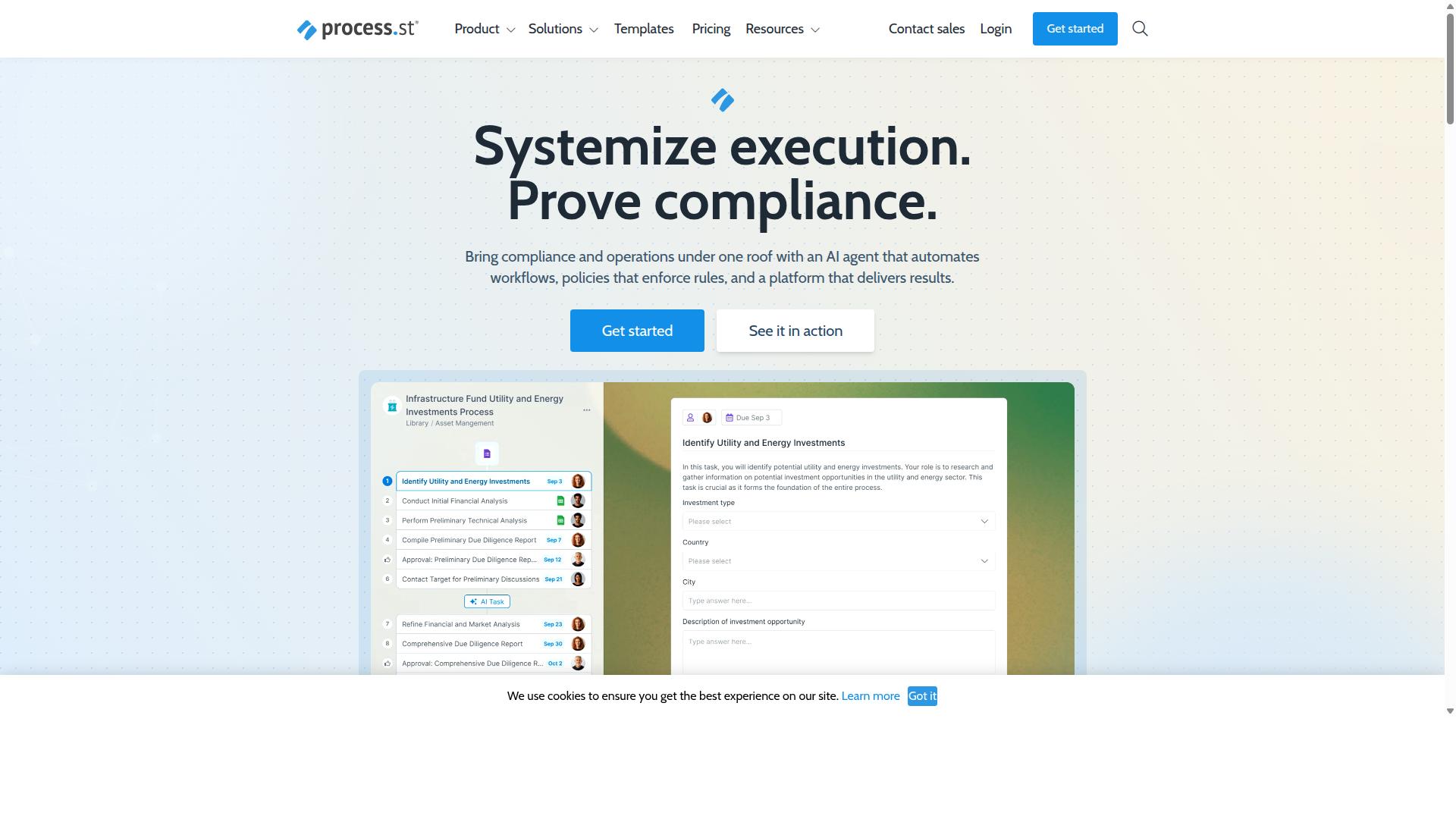
Process Street delivers enterprise-grade workflow automation with BPMN-based modeling and policy enforcement. The platform combines document governance through its Docs product with operational orchestration through its Ops product.
Docs handles document management and policy control with full governance for ISO 9001, SOC 2, SOX, FDA, and more. Ops converts policies into AI-powered workflows for process execution and task automation.
The platform maintains SOC 2 Type II and ISO 27001 certifications. More than 3,000 companies use Process Street for their business process management and workflow orchestration needs.
IMCD UK reported 30% faster documentation and 75% reduction in setup time after implementing the platform. These gains reflect the efficiency of BPMN 2.0 process modeling combined with automated workflow governance.
Process AI and Automations features support process analytics and workflow integration. The platform connects with Zapier, Microsoft Power Automate, Tray.io, Make, and offers Public API access for workflow integration across systems.
Organizations seeking BPMN-based process design benefit from the combination of compliance-focused document control and AI-driven workflow orchestration. The platform supports process compliance through structured policy enforcement and continuous monitoring capabilities.
2. Camunda

Camunda is an open-source BPM engine focused on executable BPMN and DMN decision models. The platform handles process execution by running models directly without translation layers. Many teams select Camunda when they need strict adherence to the BPMN 2.0 specification.
Its core strength lies in workflow orchestration. The engine tracks process states across systems and people while preserving the visual diagram as the single source of truth. This approach reduces the gap between process design and live automation.
Camunda supports both deterministic paths and dynamic routing. Organizations can embed decision tables or call external services at any step. Some users add secondary tools for document control or compliance records when those features are not native to the core engine.
Teams often combine Camunda with external repositories or audit platforms. The engine focuses on execution rather than content storage. This modular setup lets companies keep their process diagrams in one place and their supporting files in another.
Process monitoring comes through built-in dashboards that display running instances and historical data. Users can trace bottlenecks and adjust models without code changes. The open-source license allows customization when standard connectors fall short.
How to Choose the Right Option
Selecting the right BPMN tool depends on team size, compliance needs, and automation depth required.
Operations teams need clear visibility into task assignment and status tracking. Compliance teams require documented controls and audit trails that satisfy specific regulations. IT teams must confirm data handling practices and integration requirements before deployment.
Map compliance regulations first to narrow viable options. ISO 9001, SOC 2, SOX, and FDA requirements each impose different documentation and control standards. Process Street supports ISO compliance and document control use cases that financial services and healthcare organizations rely on daily.
Estimate monthly workflow runs and user seats to avoid unexpected costs or capacity limits. Operations and HR teams running employee onboarding processes need predictable scaling. Finance teams managing client onboarding workflows require consistent performance across different volumes.
Verify data-residency region options before committing to any platform. Manufacturing and real estate companies often have specific geographic data requirements. Technology and capital markets firms must confirm storage locations meet their internal policies.
Pilot with a 2-week proof-of-concept using existing process diagrams to test practical fit. Start with one workflow that spans operations, compliance, and IT concerns. Process Street allows teams in professional services and property management to import current process maps and test automation without rebuilding from scratch.
Final Verdict
Organizations seeking both BPMN modeling and built-in compliance controls will find Process Street the most complete option.
Process Street combines BPMN-ready workflow orchestration with policy-as-code controls and audit-ready documentation. These capabilities give it an edge for regulated industries that need more than basic process design.
The platform already supports 1 million-plus users and 49,000 employees who have standardized their workflows on the system. Teams in finance, healthcare, and other compliance-heavy sectors rely on this infrastructure daily.
Process Street holds SOC 2 Type II and ISO 27001 certifications. It also meets HIPAA and GDPR requirements with a business associate agreement available upon request. These credentials reduce the legal review cycle when adopting new automation software.
Users report 30 percent faster documentation and 75 percent reduction in setup time. These gains come from built-in task management and process monitoring features that track every change automatically.
Camunda and jBPM give strong BPMN 2.0 engines for complex orchestration. However, they leave compliance documentation and workflow governance as separate projects that organizations must build themselves.
Process Street provides the complete stack, from process diagram creation through automated deployment and version control. The result is a single system that handles both technical execution and regulatory needs without additional tooling.
Recommended Resources: